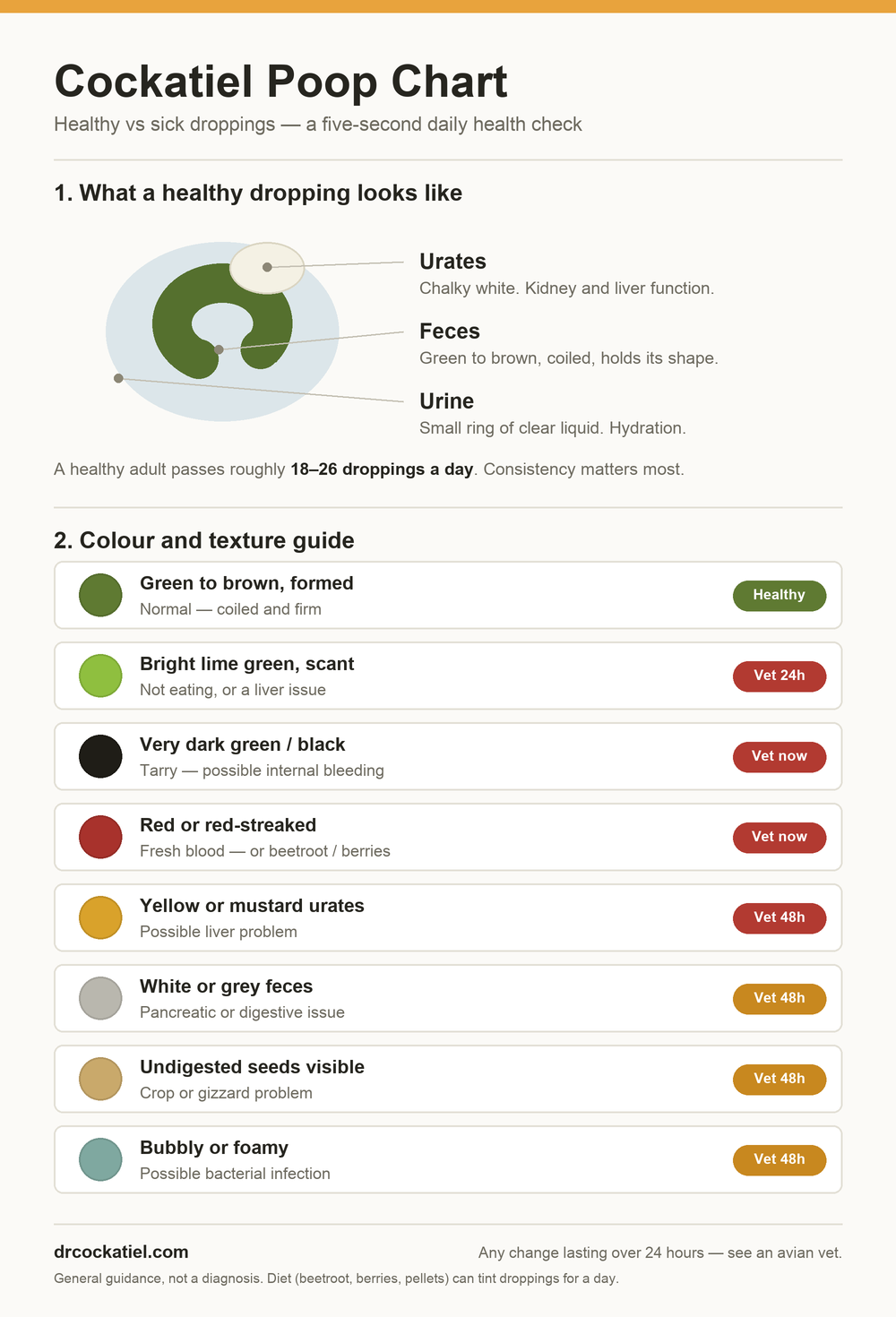
Quick answer: healthy cockatiel poop has three parts - a coiled green-to-brown feces portion, white urates, and a small ring of clear liquid urine. It should be fairly firm, mostly odourless, and consistent from day to day. A one-off odd dropping usually just reflects what your bird ate; a change that lasts more than 24 hours is one of the earliest illness signals cockatiels give you, because birds hide symptoms until they’re seriously unwell.
Checking droppings takes five seconds a day and is the single best home health check you can do. This guide shows you exactly what normal looks like, what every colour and texture change means, and when to call an avian vet.
The three parts of a healthy dropping
Birds pass everything through a single opening (the cloaca or “vent”), so each dropping contains three components at once:
| Component | Healthy appearance | What it tells you |
|---|---|---|
| Feces | Coiled, worm-like, green to brown, holds its shape | Digestive health; colour shifts with diet |
| Urates | Creamy white, chalky, sits on or beside the feces | Kidney and liver function |
| Urine | Small ring of clear liquid around the rest | Hydration and kidney function |
A healthy adult cockatiel produces roughly 18-26 droppings a day. Pellet-fed birds tend to produce browner, slightly larger droppings than seed-fed birds, whose droppings are usually darker green - both are normal for that diet.
Cockatiel poop colour chart
| Colour | Most likely cause | Action |
|---|---|---|
| Green - brown, formed | ✅ Normal (shade depends on diet) | None - this is the goal |
| Bright/lime green, scant | ⚠️ Not eating, or possible liver issue | Check food intake today; vet if it persists 24h |
| Very dark green - black, tarry | 🚨 Possible digested blood (internal bleeding) | Avian vet same day |
| Red or red-streaked | 🚨 Fresh blood - or harmless beetroot/berry pigment | If no red food eaten in 24h: vet immediately |
| Yellow or mustard urates | 🚨 Liver problem suspect | Avian vet within 24-48h |
| White/grey feces portion (not urates) | ⚠️ Pancreatic or digestive issue | Vet if repeated |
| Undigested seeds visible | ⚠️ Possible crop/gizzard problem or infection | Vet if seen more than once |
| Bubbly or foamy | ⚠️ Possible bacterial infection | Vet if repeated |
Remember the pigment rule: beetroot, berries, sweet potato and coloured pellets all tint droppings for a day. Before worrying about a colour change, ask what your bird ate yesterday - our full food safety list notes which foods do this.
Texture and volume changes
Watery droppings
Extra liquid with a normal feces coil is polyuria (excess urine) - common and often harmless after fruit, veggies, bathing or stress. A consistently loose, unformed feces portion is true diarrhea, which is much rarer and more serious. We cover the difference in detail in why is my cockatiel’s poop watery?
Large, smelly, or “bulky” droppings
A single giant morning dropping is normal - birds hold droppings overnight, and egg-laying hens produce notably larger ones all day. Genuinely foul-smelling droppings are not normal at any time and suggest a bacterial or yeast infection worth a vet visit.
Fewer or smaller droppings
Fewer droppings almost always means less food going in. Weigh your bird (see how much should a cockatiel weigh?) and monitor eating closely - a cockatiel that stops eating needs a vet within 24 hours, not a wait-and-see approach.
When to call the avian vet
- Same day: black tarry droppings, fresh blood with no dietary explanation, straining without producing anything, or droppings stuck to a fluffed, lethargic bird
- Within 24-48 hours: yellow urates, persistent watery feces, undigested seed, or any change lasting more than a day alongside reduced appetite
- Mention at next checkup: occasional post-fruit polyuria, diet-related colour shifts
Pair dropping checks with the other early warning signs in our cockatiel health symptoms guide - droppings plus posture, appetite and breathing give you a near-complete daily health picture.
A simple daily monitoring habit
- Line the cage floor with plain paper (not corn-cob or pellet litter, which hides changes).
- Each morning, glance at the overnight droppings before changing the paper: count, colour, three components present.
- Photograph anything unusual - a photo series is enormously useful to your vet.
- If something looks off, note what your bird ate in the previous 24 hours before assuming illness.
FAQs
Why is my cockatiel’s poop green?
Some green is normal - bile makes feces green-to-brown, and seed diets and leafy greens deepen it. The warning sign is bright lime-green scant droppings, which usually mean the bird isn’t eating. Confirm food intake immediately and see a vet if it continues past a day.
Why does my cockatiel poop so much?
Birds have fast metabolisms and can’t afford to carry extra weight in flight, so they void every 20-40 minutes. 18-26 droppings a day is completely normal; see how often do cockatiels poop? for the full breakdown. You can even train a cockatiel to poop in one place.
Is it normal for my cockatiel to eat its poop?
It happens, and it’s usually boredom or a mineral-seeking behaviour rather than illness - but it’s worth addressing. See why do cockatiels eat their poop? for causes and fixes.
What does egg-laying do to droppings?
Hens in laying condition produce much larger, wetter, smellier droppings - that’s hormonal and normal during laying. If your hen lays often, read how often do cockatiels lay eggs without mating? - chronic laying has its own health risks.
This guide is general information, not a diagnosis. Droppings are an early-warning system - when they change and stay changed, an avian vet visit is always the right call.